Raising sound,
healthy, well socialized puppies is difficult work with very specific demands.
Quality breeders care about the animals they produce, and are justifiably proud
of their puppies' pedigrees. These responsible breeders, members of legitmate,
long-established breed registries such as the American Kennel Club (AKC), the
United Kennel Club (UKC), and comparable registries in other countries, take
pride in producing sound, happy puppies/ dogs who are the best examples of
their breed that they can be. We appreciate these Breeders With Pride, who have
supported efforts to eliminate puppy mills. (Please see
Breeders With Pride: Responsible Breeders Speak Out:
for some of their personal insights into responsible pet breeding. )
Unfortunately,
there are also the commercial and "backyard" breeders whose only
motivation is profit.
|
| |
|

|
What is the
connection between breed registries (aka "papers") and Puppy
Mills?
Most people who
breed purebred dogs claim some affiliation with a registry as a seal of quality
for their puppies. Many use that affiliation as a marketing tool, but buyers
often learn the hard way that an AKC/ UKC puppy purchased from a pet store or a
backyard breeder is highly unlikely to be of the same caliber as an AKC/ UKC
registered puppy purchased from a reliable breeder. They may also encounter a
bewildering array of different registries such as American Canine Association,
Continental Kennel Club Inc. or others that they are told by the seller are
"just as valid" or even better than the AKC or UKC.
|
| |
|
|
What does
"registration" really mean?
All breed
registration means is that breeders of the puppy's parents, grandparents, and
antecedents back a specified number of generations paid a fee and got the pup's
name listed in an archive. Period. That's all it means. Registration is neither
a guarantee nor even an indication of quality. Nor does it tell you WHERE your
puppy came from, if you buy it from a pet store, even if there is a kennel or
breeder name listed. It certainly doesn't guarantee that the puppy didn't come
from a "puppy mill" -- you know, those horrible places you hear about
where the dogs live in deplorable conditions and are bred solely for profit,
with no thought to the pain and suffering inflicted on these poor animals --
because some puppy millers make up their own registries!
|
| |
|
|
Who is the AKC and
what do they do?
The American
Kennel Club, established in 1884, was formed originally to promoting the sport
of purebred dogs and breeding for type and function. The organization maintains
a purebred dog registry, sanctions dog events, and promotes responsible dog
ownership. AKC registration means a dog, its parents, and its ancestors are
purebred, but it does not indicate health or quality.
Note the words
"Kennel Club." The origin of the established breed registries such as
the AKC and the UKC (United Kennel Club) was just that -- basically, a social
club for dog afficianados to get together and enjoy their animals. Both have
their own websites, and you might be interested in taking a look for yourself.
|
| |
|
|
Registration and the
"Quality" of your Pet Shop Puppy
There is a widely
held belief that registration "papers" guarantee quality. This is
just not true. A registration certificate identifies the dog as the offspring
of a known sire and dam, born on a known date and NOTHING MORE.
"Papers" DO NOT indicate quality or promise a healthy dog.
Commercial and large-scale breeders and many "back yard breeders" who
breed dogs for profit, don't really care about the quality demands of meeting a
breed standard -- this is proven again and again by millers who breed for
"rare" non-standard colors, even though these colors have been proven
to be linked to genetic disabilities such as deafness. We have also discovered
over the many years we have been dealing with these profiteers that they will
actually keep puppies with known physical and genetic defects as breeders, if
they cannot sell them to unsuspecting pet shoppers.
Too many people
believe that if they buy a dog that is "registered," it means that it
came from a responsible, knowledgeable breeder who actually "cared"
about the puppies they were breeding. Don't be mislead. See
"Indy's Story" elsewhere on
our website for one example.
By the way, buyers
are responsible for getting the registration paperwork from the seller. When
'papers' are not available at the time of delivery, it is a red-flag warning
sign to exercise extreme caution.
Please see the
Dog Registration FAQ page and
Rules Applying to Registration and Discipline for the full
American Kennel Club explanation of their Registry and how it works. This is
interesting reading, addresses many misconceptions, and also spells out the
AKC's responsbilities, the breeder/seller's responsibilities, and the buyer's
responsibilities.
|
| |
|
|
A Note on Other Breed
Registries:
The AKC, founded
in 1884, is the oldest and largest breed registry organization in the US; the
UKC or United Kennel Club, was established in 1898 and is the second oldest
breed registry in the US. Both emphasize breeding for elimination of genetic
disabilities, have club-wide codes of ethics for breeding and competitions, and
now actively work to discourage irresponsible breeders. (Please see
http://www.akc.org/ and/or
www.ukcdogs.com/ for more
information.)
While some
alternative breed registries were legitimately formed to promote and register
established breeds, including those not recognized by the AKC, many new
registries have been formed by puppy millers whose registry privileges have
been revoked by the AKC or UKC due to complaints about breeding practices, who
are breeding so-called "hybrid dogs," or who just don't want to be
bothered with the fees or paperwork required by the traditional kennel clubs.
For more on the
topic of breed registries, and a list of questionable breed registries, please
see About Dog
Registries and Kennel Clubs on one of my all-time favorite informational
websites, Wonderpuppy.net. This website also features an outstanding
satire on
the proliferation of "new" breed registries (also known as
"paper mills")
|
| |
|
|
When Breed Registries can
actually harm dogs:
Breed registries
not only register the ancestry of pure-bred dogs, they also define what the
dogs should look like, how they should hold their tails, what their temperament
should be, etc. The stated purpose of disqualifying non-desirable traits is to
eliminate them from the gene pools. This is often a good thing, as in the case
of some colorings and markings that appear to be genetically linked with
disorders such as deafness, etc.
A scrupulous
breeder will generally sell animals exhibiting "disqualifying" traits
as pets only, on a spay/neuter contract. However, a puppy miller will either
breed with total disregard for the consequences, or destroy the puppies
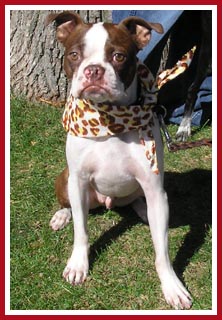
(generally by less than humane means). The liver Boston Terrier pictured on the
left is an example: he was rescued as a puppy from a dumpster at a puppy mill
auction -- back before millers discovered that they could charge premium prices
for non-standard colors! (You can read about him
here.)
|
|